Anthropic Launches "Claude Science," an AI Workbench Aimed at Biology and Drug Discovery
The company behind Claude has released a research environment that pulls genomics, proteomics, and cheminformatics tools into one place — and is offering academic labs up to $30,000 in credits to try it.
media age.house
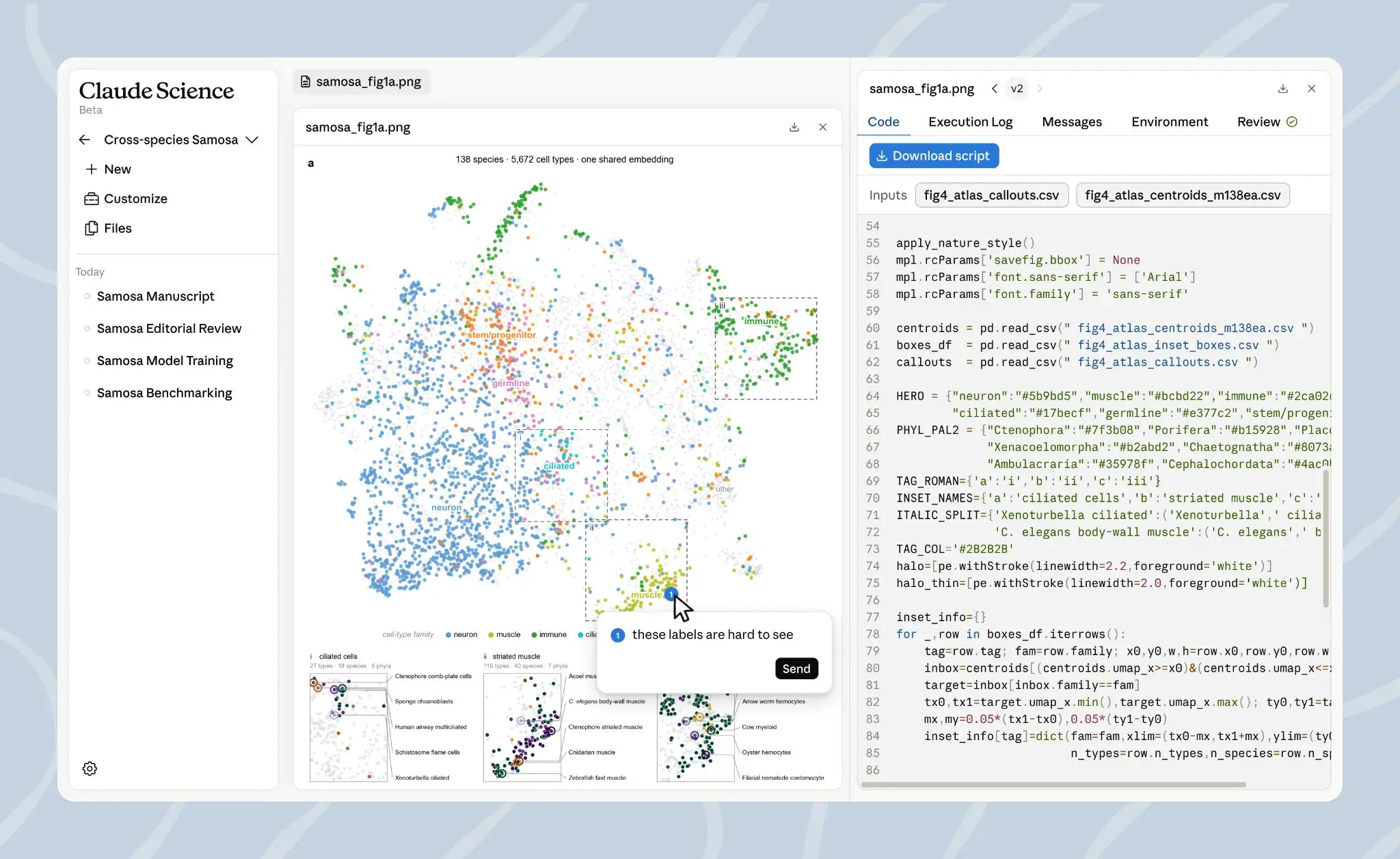
Anthropic has launched Claude Science, an AI “workbench” for researchers, the company announced on June 30, 2026. The product is pitched as a single environment that unifies the scattered databases, tools, and platforms — PubMed, Jupyter, R, cluster terminals — that scientists normally juggle across separate windows.
For an audience focused on aging and longevity, the notable part is where it points: Claude Science is built first for biology-heavy fields — genomics, single-cell analysis, proteomics, structural biology, and cheminformatics — the same disciplines that underpin much of modern drug discovery and aging research.
What It Does
At the center is a generalist coordinating agent with access to more than 60 curated “skills,” which can spawn specialist agents for particular tasks. Anthropic highlights several capabilities aimed at scientific work specifically:
- Native rendering of scientific artifacts — 3D protein structures, genome tracks, and chemical structures — inside the workspace;
- Reproducibility by default, with complete code history and message logs;
- Automated compute management across local machines, HPC clusters, or on-demand GPU resources;
- A built-in reviewer agent that checks citations and calculations;
- Session forking, to compare different analytical approaches side by side; and
- Pre-configured connectors to more than 60 scientific databases.
It integrates with NVIDIA’s BioNeMo Agent Toolkit — including the Evo 2, Boltz-2, and OpenFold3 models used in genomics and protein structure — and with the compute platform Modal, which is offering up to $2,000 in credits to users.
Early Users
Anthropic pointed to several institutions already testing the tool:
- Manifold Bio used it for target nomination and assessment across hundreds of candidates for tissue-targeting medicines.
- The Allen Institute built automated literature reviews from thousands of papers, with AI-generated cross-study figures.
- The UCSF Brain Tumor Center applied it to germline variant analysis in studies of genetic susceptibility to glioma.
“What set Claude Science apart was that it could do this end-to-end,” across complex workflows, said Jérôme Lecoq, a neuroscientist at the Allen Institute, who built a multi-agent “computational review template” with around 20 custom skills.
Stephen Francis, an epidemiologist at the UCSF Brain Tumor Center, said the tool cut his molecular-epidemiology analysis to “roughly one-tenth the time it previously took.”
Availability and the “AI for Science” Program
Claude Science is launching in beta for Claude Pro, Max, Team, and Enterprise users, on macOS and Linux, with a Team plan available to academic institutions and nonprofits.
Alongside the launch, Anthropic opened an “AI for Science” program funding up to 50 projects with $30,000 in credits each. Applications are open until July 15, 2026, for a project period running September 1 to December 1, 2026.
Why It Matters for Longevity Research
The tools Claude Science targets — genomics, proteomics, structural biology, cheminformatics — are exactly the ones behind the aging-biology and drug-discovery work covered across this field. If the productivity claims from early users hold up beyond curated examples (one researcher citing a tenfold speedup is a data point, not a benchmark), the more interesting story is not any single feature but the compression of the research loop itself: the time between a hypothesis about a biological target and a testable result. That is the bottleneck longevity science keeps running into — and the one AI tooling is now explicitly aimed at.
Details: Based on Anthropic’s announcement, “Claude Science, an AI workbench for scientists, is now available,” dated June 30, 2026. Product capabilities and time-savings figures are as described by Anthropic and the quoted researchers, and have not been independently verified.
Disclaimer
This content is for informational and educational purposes only and is not medical advice. Always consult a qualified healthcare professional before making changes to your health.