Rentosertib Linked to a Younger Proteomic Age in an IPF Trial
Six proteomic aging clocks, applied to blood samples from a Phase IIa study of Insilico’s AI-designed lung-fibrosis drug, each pointed toward a lower predicted biological age in treated patients.
Founding Editor & Reporter
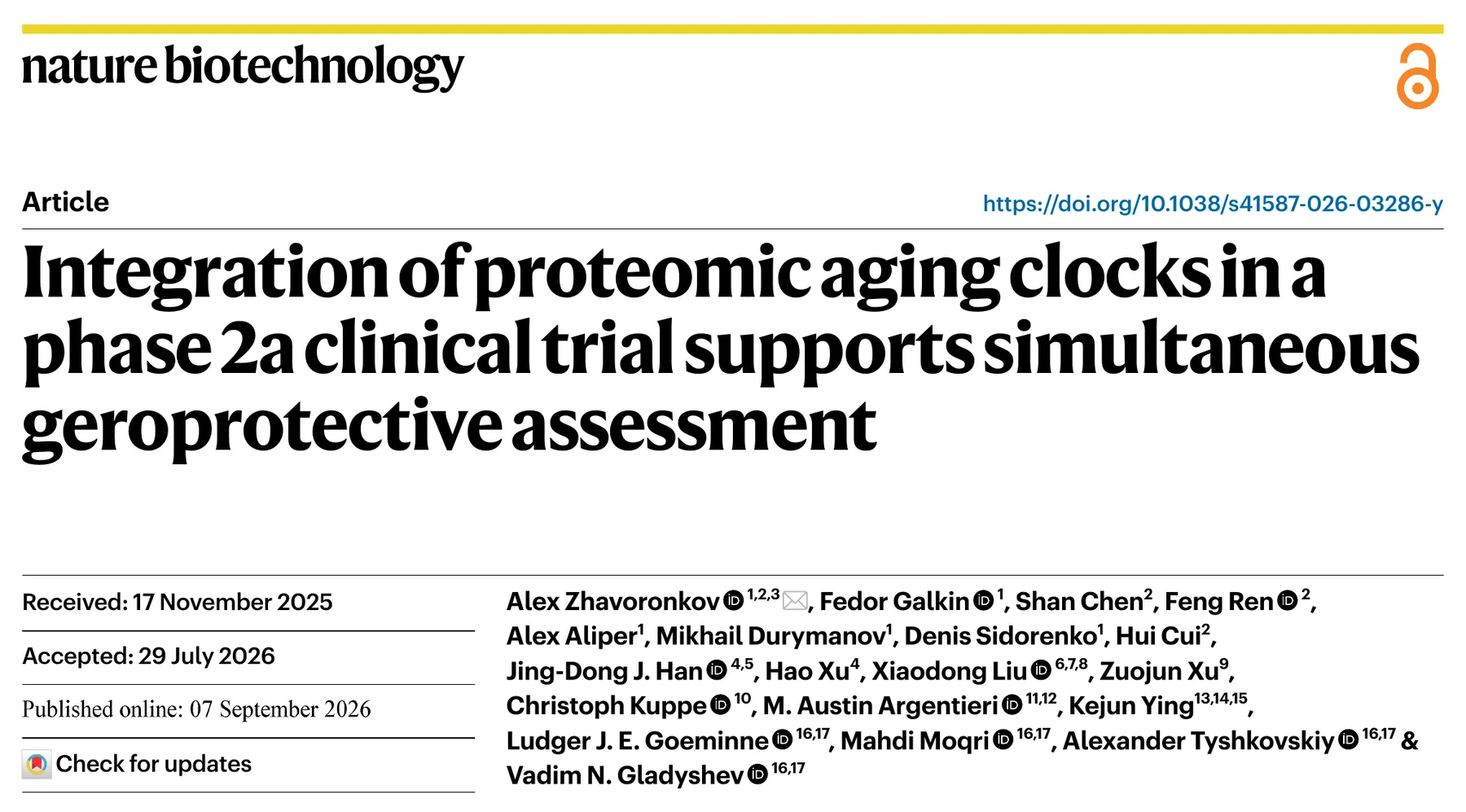
Six independent proteomic aging clocks found a lower predicted biological age in patients treated with rentosertib during a Phase IIa trial in idiopathic pulmonary fibrosis, Insilico Medicine reported on September 7, 2026.
The analysis, published in Nature Biotechnology, used blood-protein data from 42 people in the trial. Insilico ran it with scientists at Harvard Medical School, Stanford University, the Broad Institute, RWTH Aachen University, Peking University, and Westlake University.
The largest shift showed up at week 4 in people taking 30 mg twice a day: about three to four years on the clocks, and as much as six years on one of them.
Background
Rentosertib (ISM001-055) is a small molecule aimed at TNIK. Insilico says its AI target-discovery tools flagged TNIK as relevant to six hallmarks of aging and to lung fibrosis, and that its Chemistry42 platform then designed the drug. The program went from target identification to a preclinical candidate in about 18 months. Preclinical work was published in Nature Biotechnology in 2024.
Phase IIa results in idiopathic pulmonary fibrosis appeared in Nature Medicine in June 2025 (NCT05938920). That trial met its primary safety endpoint and showed a dose-related trend on forced vital capacity, a standard measure of lung function. In the 60 mg once-daily group, mean FVC rose 98.4 mL, compared with a mean decline of 20.3 mL on placebo, or 62.3 mL if an outlier is excluded. Insilico notes that IPF typically begins around age 65, and that FVC in healthy people older than 65 also tends to fall, often by 20 to 50 mL a year.
The trial had already planned to collect serum proteins over time. Those data, covering 2,841 proteins measured with Olink, are deposited at the China National Center for Bioinformation under accession OMIX008341.
Six Clocks, One Direction
The new paper applies six clocks built separately by groups including teams at Harvard, Oxford, Peking University, and Insilico: ProtAge, OrganAge in both chronological-age and mortality versions, PAC, ipfP3GPT, and PAOPAC. The methods differ. Some are classical machine learning and some are deep learning. Some were trained on chronological age and some on mortality risk. All six moved toward a younger predicted age in the rentosertib arms compared with placebo.
Insilico says the age signal did not simply follow the lung result. The dose that improved breathing the most was not the dose with the strongest age-clock change.
A comparison with 55,319 UK Biobank protein profiles found that rentosertib pushed age-related protein patterns back toward a younger profile. The company describes the drug as senomorphic: it suppressed proteins tied to cellular senescence, including EREG, ESM1, IGFBP4, ITGA2, MMP10, MMP13, and SPP1, and it turned down growth-factor pathways associated with faster aging, including RTK–PI3K and RAS–ERK.
2013 Nobel laureate Michael Levitt, who was not an author of the trial, said the agreement across clocks is what he finds convincing, because the models do not share features or training data. He also said the study cannot yet separate slower aging from the effect of treating a damaged lung, and that a trial in healthy volunteers is the experiment he wants next.
Harvard Medical School research fellow Ludger Goeminne, a co-author, said the reductions showed up across organ-specific clocks and that pathway analysis put the drug’s effect beyond a reduction in fibrosis alone.
What’s Next
Insilico says the paper is a template for adding aging measurements to ordinary disease trials: collect senescence and aging markers as exploratory endpoints, then seek qualification under the FDA’s biomarker program. The analysis code is public as a Python library, and the data remain at accession OMIX008341.
Zhavoronkov was scheduled to present the results on September 8, 2026, at a Nature conference at Sorbonne University in Paris. Rentosertib is in Phase III testing in China. IPF affects about 5 million people worldwide and has a median survival of three to four years. Approved drugs can slow it. They do not stop or reverse it.
The Study at a Glance
- Drug: Rentosertib (ISM001-055), a TNIK inhibitor
- Company: Insilico Medicine
- Paper: Nature Biotechnology, 2026
- Cohort: 42 participants from a Phase IIa IPF trial
- Measurement: 2,841 serum proteins (Olink)
- Clocks: ProtAge, OrganAge (two versions), PAC, ipfP3GPT, PAOPAC
- Peak signal: About 3–4 years at week 4 on 30 mg twice daily; up to 6 years on one clock
- Data: CNCB accession OMIX008341
Disclaimer
This content is for informational and educational purposes only and is not medical advice. Always consult a qualified healthcare professional before making changes to your health.